
Thinking Scientifically
In this session, we’ll explore the meaning of science and discuss whether the scientific method can be meaningfully applied to the study of society. To do this, we’ll try to ans...
View session: Thinking ScientificallyFall 2026
A course on organizing theory, history, strategy, and tactics. Session readings, slides, and discussion questions are listed below.
10 sessions
In this session, we’ll explore the meaning of science and discuss whether the scientific method can be meaningfully applied to the study of society. To do this, we’ll try to ans...
View session: Thinking ScientificallyIn this session, we’ll start to apply our understanding of science so that we can approach the study of society (and its motion; i.e. history) scientifically. We’ll develop a co...
View session: Toward a Science of SocietyIn this session, we’ll begin to discuss political economy - what some might call the science of commodity production. This week is all about the historical processes that were n...
View session: The Birth of the Capitalist Mode of ProductionIn this session, we’ll discuss the economic laws of capitalist development and how they help explain its historical development. Make sure to put your algebra hat on because the...
View session: The Capitalist Production & Accumulation ProcessIn this session, we’ll learn about imperialism, i.e. the monopoly stage of capitalism. We’ll talk about the relationship between the formation of monopolies and the rule of fina...
View session: Imperialism and the General Crises of CapitalismIn this session, we’ll make the leap from production to class struggle. We’ll identify the different roles and relationships that people have in the social production process an...
View session: Do You Have Class (In Your Analysis)?In this session, we’ll develop an understanding of strategy and tactics in the context of the battle between the working class and the capitalist class. Here, we’ll be discussin...
View session: The Battle of the ClassesIn this session, we’ll develop an understanding of what it means to be a fighting political organization! We’ll discuss the necessity of organization in challenging the ruling c...
View session: Organizing the PeopleIn this session, we’ll learn about the nature of leadership of the masses by political organizations. In particular, we’ll discuss the nuances of the mass line method of politic...
View session: Movement Leadership & Unity and StruggleIn this session, we’ll learn about the necessity of consciousness raising as a part of class struggle. Together, we’ll talk about the different forms that consciousness-raising ...
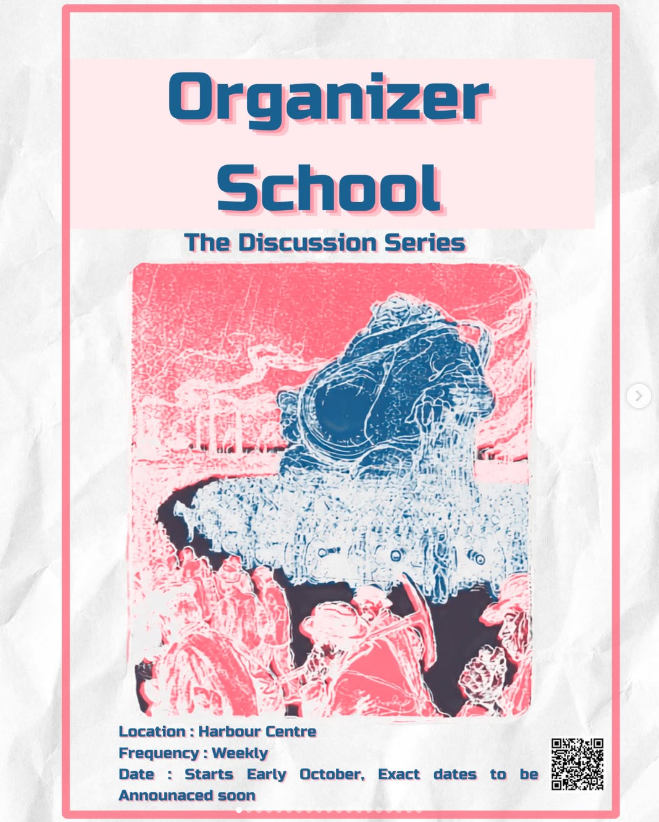
View session: Raising ConsciousnessWelcome to Organizer School 2026! Organizer school is aimed at people who are interested in organizing or are already organizing and want to have a critical understanding of the theory, historical practice, strategies and tactics that have been used in organizing. Organizer school also gives you an opportunity to discuss and debate your ideas with other organizers in the city!
We will be meeting every week for discussion sessions. All sessions will take place at SFU Harbour Centre, Rm 2200.
Every week, we will release session pages with all the materials you will need to prepare for sessions, including slides and readings. Access all session pages in the Organizer School Landing Page or through this syllabus page, which will be updated weekly.
Discussion Group Details
📆 Every Thursday starting 8 October 2026
⏰ 6-8pm (Add to calendar)
📍 SFU Harbour Centre Room 2200
In the first two weeks, we’ll be learning about science and how to study society scientifically. In particular, we’ll be exploring a bit of “theory” and developing our ability to differentiate between theoretical frameworks (scientific vs. un-scientific) and understand what kinds of political and organizational practices correspond to each of the frameworks.
In the three weeks that follow (weeks 3 to 5), we’ll dip our toes into political economy, the study of society’s system of production (i.e. its economy). In our brief overview, we’ll learn about the role of economic forces in the development of history, what these forces can tell us about what’s going on in the world today, and how to evaluate the material, economic interests of different social groups based on their role in the economy (i.e. the interests of different classes).
In the five weeks that follow (weeks 6 to 10), we’ll review the lessons we’ve learned from the successes and failures of revolutionary mass movements, the successes and failures of class struggle. We’ll learn about strategy and tactics, organization and power, political leadership and the formation of mass demands, the importance of building unity through struggle, and how we raise the consciousness of the broad masses of people.